
Table of Contents
Roadside Assistance vs. Towing: Which One Do You Need?
Car trouble is stressful, especially when you are stuck in Los Angeles traffic, inside a parking garage, near a freeway, outside work, or in an apartment parking lot.
The first question is simple:
Do you need roadside assistance, or do you need towing?
Certified Roadside Assistance helps drivers across Los Angeles with both. If the problem can be handled safely where your vehicle stopped, roadside assistance may be enough. If your vehicle cannot be driven safely, towing services may be the safer choice.
Open Daily: 8:00 AM–12:00 AM
Call (310) 343-3357
1. Quick Answer
Choose roadside assistance if your vehicle problem can be fixed safely on-site.
Choose towing if your vehicle cannot be driven safely or needs to be moved to another location.
You may need roadside assistance for:
- Dead batteries
- Flat tires
- Car lockouts
- Fuel delivery
- Minor on-site vehicle problems
- Motorcycle roadside help
You may need towing for:
- Accident damage
- Non-drivable vehicles
- Stuck vehicles
- Parking garage towing
- Low-clearance vehicle towing
- Long-distance vehicle transport
- Vehicles that may be unsafe to drive
If you are not sure, call and explain what happened. A clear description of your location, vehicle, and problem helps determine the safest option.
2. What Is Roadside Assistance?
Roadside assistance is helpful for vehicle problems that can often be handled where your vehicle stopped.
The goal is simple: get you moving again without towing the vehicle if it is safe to do so.
Roadside assistance is often the right choice when the issue is clear, the vehicle is in a safe location, and the problem can be handled on-site.
Common roadside services include:
- Jump Start Service
- Tire Change Service
- Car Lockout Service
- Fuel Delivery
- Car Battery Replacement
- Emergency roadside help
- Motorcycle roadside help
Roadside help is usually best when your vehicle is not badly damaged and does not need to be transported.
3. What Is Towing?
Towing is used when your vehicle needs to be moved from one place to another.
You may need a tow truck if your vehicle cannot be driven safely, was involved in an accident, is stuck, has major damage, or needs transport to a repair shop, dealership, home, hotel, storage location, or another address.
Common towing services include:
- Tow Truck Service
- Flatbed Towing
- Accident Towing
- Parking Garage Towing
- Winch-Out Recovery
- Low-Clearance Exotic Towing
- Motorcycle towing
- Long-distance towing
Towing is the safer choice when driving could cause more damage or put you, your passengers, or other drivers at risk.
4. Roadside Assistance vs. Towing: The Simple Difference
The difference comes down to one question:
Can the vehicle be helped safely where it is?
If yes, roadside assistance may work.
If not, towing is usually the better option.
Choose Roadside Assistance When the Problem Can Be Fixed On-Site
You may only need roadside help if:
- Your battery is dead
- You have a flat tire and a usable spare
- Your keys are locked inside the car
- You ran out of fuel
- Your vehicle is stopped but not badly damaged
- The vehicle is in a safe location
- The problem does not require a repair shop right away
For example, if your car will not start in an apartment lot, a jump start may be enough.
If you are locked out near work, car lockout service may solve the problem without a tow.
Choose Towing When the Vehicle Cannot Be Driven Safely
You may need towing if:
- Your vehicle was in an accident
- The wheels, steering, suspension, or frame may be damaged
- The vehicle is stuck and cannot move
- The car has missing wheels or severe tire damage
- The vehicle will not start after roadside help
- The vehicle is in a parking garage and cannot move safely
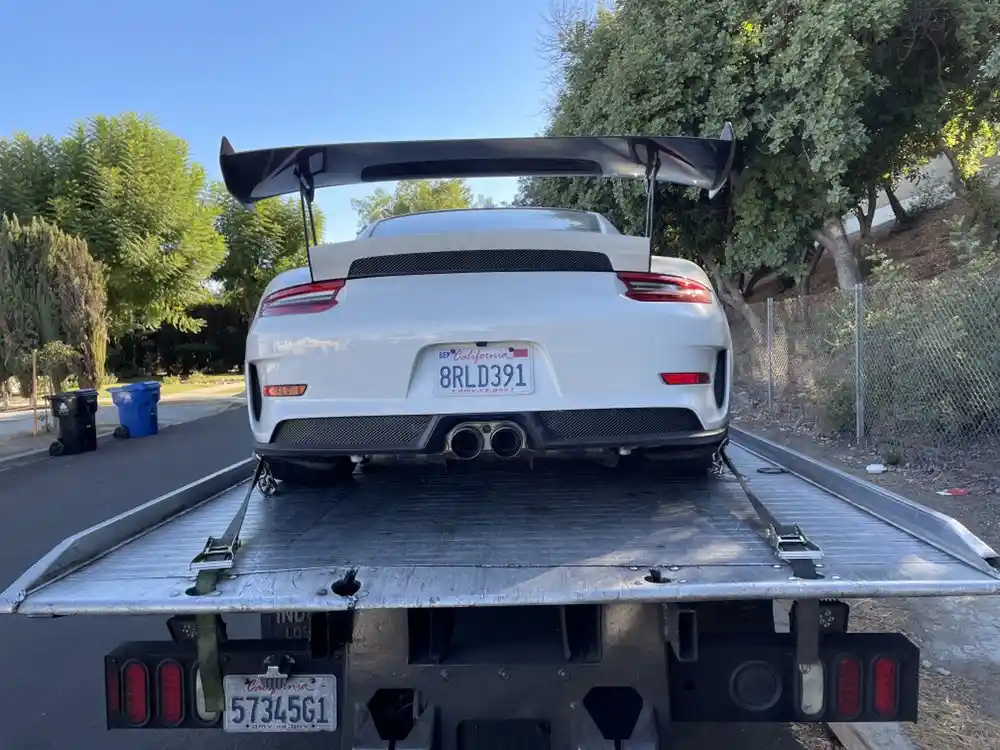
- You drive a low-clearance, luxury, classic, EV, or specialty vehicle that needs careful transport
- You need the vehicle moved to a repair shop, dealership, home, or another city
For example, after a crash, accident towing is usually safer than trying to drive “just a few blocks.”
If your vehicle is stuck in a tight garage or low-clearance area, parking garage towing or flatbed towing may be the better setup.
5. When You Should Not Drive the Vehicle
Do not drive the vehicle if it may be unsafe.
Call for help before driving if:
- The steering feels loose or difficult
- The brakes are not working normally
- A tire is shredded, missing, or flat with no usable spare
- The wheel or rim looks damaged
- Body damage is rubbing against a tire
- The vehicle is leaking fluid
- The vehicle was involved in an accident
- The vehicle is stuck and cannot move cleanly
- Warning lights appear after a crash or breakdown
- Driving could make the damage worse
If any of these apply, towing may be safer than trying to move the vehicle yourself.
6. Common Situations and Which Service to Choose
Use this guide if you are stuck and unsure what to request.
Your Car Will Not Start
If your car will not start, start with the battery.
A dead or weak battery may only need a jump start. If the battery is failing, car battery replacement may be needed.
Choose roadside assistance if the vehicle may start with battery help.
Choose towing if the vehicle still will not start, has a larger mechanical issue, or cannot be driven safely.
You Have a Flat Tire
A flat tire does not always mean you need towing.
Choose tire change service if you have a usable spare and the vehicle is in a safe place.
Choose towing if:
- You do not have a usable spare
- More than one tire is damaged
- The wheel or rim is damaged
- The vehicle is in an unsafe location
- Driving after the tire issue could cause more damage
If you are near moving traffic, stay away from the roadway and call from a safe place.
You Locked Your Keys in the Car
A lockout usually does not require towing.
If your keys are locked inside your vehicle, car lockout service may be enough. Share your exact location, vehicle make and model, and any access details.
Choose roadside assistance for most lockouts.
Choose towing only if there is another issue, such as damage, a no-start problem, or an unsafe location.
You Ran Out of Gas
If you run out of gas, fuel delivery may be enough to get you moving.
Choose roadside assistance if the vehicle is otherwise safe to drive.
Choose towing if the vehicle still will not start, is in a dangerous location, or has another mechanical problem.
You Were in an Accident
After an accident, do not assume the vehicle is safe to drive.
Damage can affect the wheels, steering, suspension, frame, tires, or body panels. Even if the car starts, driving may make the damage worse.
Choose accident towing if:
- The vehicle is not safe to drive
- The wheels or tires look damaged
- The steering feels wrong
- The vehicle is leaking fluid
- Body damage is touching a tire
- You need the vehicle moved to a shop, home, or another address
If you are unsure, call and describe the damage before trying to drive.
Your Vehicle Is Stuck
If your vehicle is stuck, avoid spinning the wheels. That can make the situation worse.
Choose winch-out recovery if the vehicle is stuck in:
- Soft ground
- Sand
- Mud
- A slope
- A tight spot
- A driveway
- A parking lot
- A blocked access area
Choose towing if the vehicle cannot be moved safely after recovery or needs transport to another location.
You Are in a Parking Garage
Parking garages can make towing more complex. Low clearance, tight turns, ramps, and blocked exits can change the right setup.
If your vehicle is inside a garage, tell the dispatcher:
- The garage name or address
- The parking level
- The entrance location
- The posted clearance height
- Whether the vehicle can roll or steer
Choose parking garage towing if the vehicle cannot move safely inside the garage.
Choose roadside assistance if the issue is a dead battery, lockout, or flat tire that can be handled on-site.
You Drive a Low-Clearance, Luxury, Classic, or EV Vehicle
Some vehicles need extra care during loading and transport.
Choose flatbed towing or low-clearance towing if your vehicle is:
- Lowered
- Luxury
- Exotic
- Classic
- Electric
- Specialty
- Not safe for standard towing
- At risk of scraping on ramps or steep driveways
Tell the dispatcher before help is sent if your vehicle needs careful handling.
7. Los Angeles Situations Where the Right Choice Matters
In Los Angeles, the right service often depends on access, traffic, and safety.
A vehicle problem on a quiet residential street is different from a breakdown near I-405, I-10, US-101, I-110, PCH, a parking garage, or a busy event area.
Near a Freeway or Busy Road
If you are near moving traffic, safety comes first.
Do not stand near the roadway. Move to a safer location only if you can do so safely.
When you call, share:
- Freeway name
- Direction of travel
- Nearest exit
- Cross street
- Landmark
- Map pin
A freeway-adjacent breakdown may need urgent roadside help or towing depending on the vehicle condition.
Inside an Apartment Lot, Hotel Lot, or Business Parking Area
Many calls start in apartment lots, hotel garages, shopping centers, and office parking areas.
These locations often need access notes, such as gate codes, garage levels, clearance limits, or valet instructions.
Roadside help may solve a battery, lockout, fuel, or tire issue.
Towing may be needed if the vehicle cannot move safely.
Near a Beach, Hillside, or Tight Street
Beach areas, hillside roads, steep driveways, and tight streets can make recovery harder.
If your vehicle is stuck, low to the ground, or in a tight space, explain the surface and access before dispatch. This helps avoid sending the wrong setup.
8. What to Tell the Dispatcher
Clear details help send the right help the first time.
When you call, share:
- Your exact location, such as an address, cross street, landmark, parking garage, freeway exit, or map pin
- Your vehicle type, such as car, SUV, truck, motorcycle, EV, luxury vehicle, classic car, or low-clearance vehicle
- What happened, such as a dead battery, flat tire, lockout, accident, stuck vehicle, no-start issue, or out-of-fuel situation
- Whether the vehicle can roll, steer, brake, or start
- Access notes, such as a garage level, clearance height, gate code, valet area, tight space, slope, or blocked entrance
- Your destination if towing is needed
The more accurate your details are, the easier it is to choose the right service.
9. Can Roadside Assistance Switch to Towing?
Yes. Sometimes roadside assistance is the right first step, but towing becomes necessary.
For example:
- A jump start does not work
- A tire cannot be changed safely
- The vehicle has no usable spare
- A lockout turns into a no-start issue
- The vehicle is damaged
- The vehicle cannot be driven after roadside help
If the problem cannot be fixed on-site, towing may be needed to move the vehicle to a repair shop, dealership, home, hotel, storage location, or another destination.
10. Final Thoughts
Choosing between roadside assistance and towing does not have to be complicated.
If the problem can be fixed safely where your vehicle stopped, roadside assistance may be enough. That often includes a dead battery, flat tire, lockout, or fuel delivery issue.
If the vehicle cannot be driven safely, was damaged in an accident, is stuck, or needs to be moved to another location, towing is usually the safer choice.
The most important thing is not to guess when safety is involved. If you are near traffic, inside a parking garage, stuck on uneven ground, or unsure whether your vehicle is safe to drive, call and explain the situation before trying to move it.
Certified Roadside Assistance helps drivers across Los Angeles and nearby communities with roadside assistance, towing, jump starts, tire changes, lockouts, fuel delivery, accident towing, parking garage towing, flatbed towing, and urgent roadside problems.
Open Daily: 8:00 AM–12:00 AM
Call (310) 343-3357
Frequently Asked Questions
What is the main difference between roadside assistance and towing?
Roadside assistance helps with problems that can often be fixed where your vehicle stopped, such as dead batteries, flat tires, lockouts, and fuel delivery. Towing is used when the vehicle cannot be driven safely or needs to be moved to another location.
Should I call for roadside assistance or a tow truck if my car will not start?
Start with roadside assistance if the issue may be a dead battery. A jump start may solve the problem. If the vehicle still will not start or cannot be driven safely, towing may be needed.
Do I need towing for a flat tire?
Not always. If you have a usable spare and the vehicle is in a safe location, tire change service may be enough. If there is no usable spare, the wheel is damaged, or the vehicle is unsafe to drive, towing may be the better option.
Does a car lockout require towing?
Usually, no. Most lockout situations only need car lockout service. Towing may only be needed if there is another problem, such as accident damage, a no-start issue, or an unsafe location.
When should I choose accident towing instead of roadside assistance?
Choose accident towing if your vehicle is not safe to drive after a crash. This may include damage to the wheels, suspension, steering, frame, tires, or body panels.
Should I request a flatbed tow truck?
A flatbed tow truck may be the better choice for low-clearance vehicles, luxury vehicles, EVs, classic cars, accident vehicles, and vehicles that cannot roll safely.
Can roadside assistance become towing if the first fix does not work?
Yes. If roadside assistance does not solve the issue or the vehicle cannot be driven safely, towing may be the next step.
What information should I have ready before I call?
Have your exact location, vehicle type, problem, access notes, and towing destination ready. These details help determine the right service and avoid delays.