

By Certified Roadside Assistance | Updated November 2026
Your bike sputters out on the 405 near the Getty Center exit. Or it won’t start after a ride up Topanga Canyon. Either way, you’re stuck on the roadside with no cabin to wait in. What you do next keeps you safe and protects your bike.
This guide shows you what to do when your motorcycle breaks down in Los Angeles. You’ll learn how to get off the road safely, which problems you can fix on the spot, and how a tow company should move your bike. That way, when you need motorcycle towing in Los Angeles, you’ll know exactly what to ask for.
Quick answer: If your motorcycle breaks down in LA, signal, get as far off the road as you can, and move away from traffic. Turn on your hazard lights if your bike has them, and keep your bright gear on. Next, check the fuel, kill switch, and kickstand. If the bike still won’t run, call for a flatbed or motorcycle trailer with a wheel chock and soft straps. Certified Roadside Assistance tows motorcycles 24/7 at (310) 343-3357.
What to Do When Your Motorcycle Breaks Down
Riders face different risks than drivers. You can’t wait inside a locked car, so your first moves matter even more.
1. Signal and Get Off the Road
At the first sign of trouble, signal and head for the shoulder, an exit, or a side street. The California Motorcyclist Handbook says to check that the roadside is firm, signal, and get as far off the road as you can. If the throttle sticks, it advises hitting the engine cut-off switch and pulling in the clutch at the same time.
2. Move Away From Traffic
Once you stop, get off the bike and step away from the travel lanes. If a guardrail or barrier runs along the shoulder, wait behind it. Never stand between your bike and passing traffic.
3. Make Yourself Easy to See
Turn on your hazard lights if your bike has them. Keep your bright or reflective gear on, too. The DMV handbook notes that your body makes up half of what other drivers see of you and your bike. In addition, California’s expanded Move Over law, in effect since January 1, 2026, requires drivers to slow down or change lanes for stopped vehicles with hazard lights on.
4. Run Quick Checks
Before you call, check the simple things. A bumped kill switch, a lowered kickstand, or a bike left in gear can all keep the engine from starting. Also check your fuel level and whether the lights come on. The table below covers the most common problems.
5. Share Your Exact Location
Help arrives faster with a precise spot. Note the road name, your direction, and the nearest exit or cross street. On canyon roads, drop a pin in your phone’s map app while you still have a signal.
6. Call for the Right Help
Some problems need a quick fix. Others need a tow. Our guide to roadside assistance vs towing explains the difference. If you feel unsafe or your bike blocks a lane, call 911 first.
Common Motorcycle Breakdowns and Quick Fixes
Most roadside trouble on a bike falls into a few groups. Use this table to decide your next move.
| Problem | Common Signs | What to Try | When to Call a Tow |
| Out of gas | Sputtering, then a stall | Switch to reserve if your bike has one | No reserve left, or you’re on a busy freeway |
| Dead battery | Clicking, dim lights, or no power | Check the kill switch, then try a jump | It won’t start or hold a charge after a jump |
| Flat tire | Wobble, heavy steering, or a soft feel | Stop riding right away | Almost always, since bikes carry no spare |
| Chain or belt failure | Engine revs, but the bike won’t move | Roll off the throttle and brake to a stop | Always |
| Overheating | Temperature light, steam, or a hot smell | Shut off the engine and let it cool | Coolant leaks or the light comes back |
| Engine seizure | The engine locks up suddenly | Squeeze the clutch and coast to a stop | Always |
A few notes on the top three problems:
- Out of gas: Newer bikes often have a low-fuel light instead of a reserve setting. If you run dry, ask about fuel delivery. Our guide on running out of gas on the freeway covers freeway safety, too.
- Dead battery: You can jump a bike from a car, but keep the car’s engine off. RideApart warns that a running car can damage the bike’s electrical system. For more, read what to do when your battery is dead.
- Flat tire: Riding on a flat makes the bike hard to control. Bikes don’t carry a spare, so a flat usually means a tow. See our flat tire safety tips for more.
Why Motorcycles Need Special Towing
A car rests on four wheels. A motorcycle, however, can’t stay upright on a moving truck without help. So the wheel-lift hookup used for many cars doesn’t work for bikes.
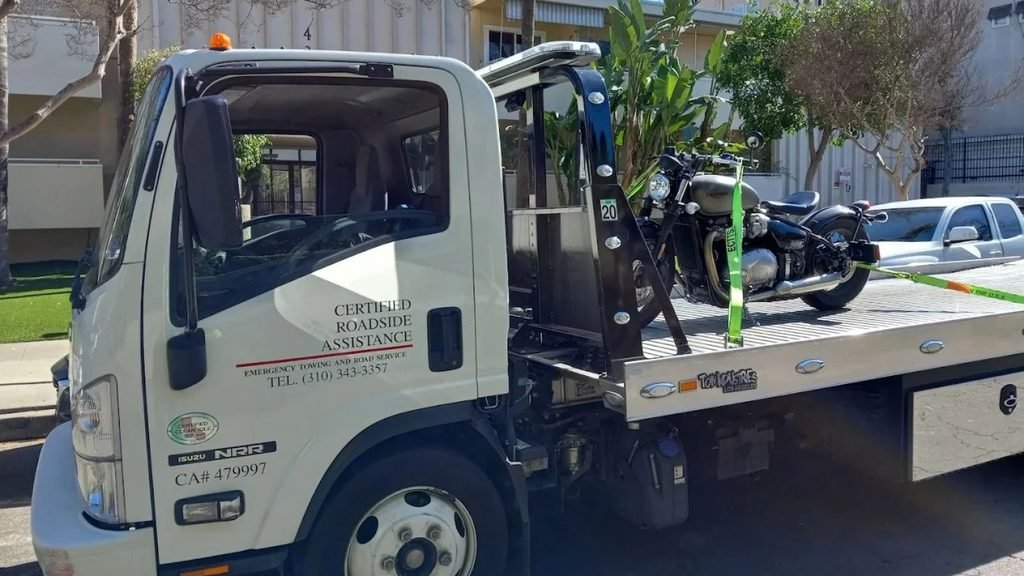
Instead, a motorcycle should ride on a flatbed or a motorcycle trailer. A wheel chock holds the front tire, and soft straps pull the bike down from solid points, like the lower fork clamp or the frame. The straps should compress the suspension slightly, so the bike stays tight over bumps.
Poor tie-downs cause real damage. Straps over plastic fairings can crack them, and hooks near cables or brake lines can bend or cut them. That’s why the company and the truck matter. Ask for flatbed towing with the right gear for bikes.
What to Check When the Tow Truck Arrives
Before the driver loads your bike, take two minutes to check these items:
- The company name: Make sure it matches the company you called.
- A written estimate: In California, the operator generally must give you a written, itemized estimate before the hookup when you’re with your vehicle.
- Photos: Take pictures of the bike from every side before it moves.
- Loose items: Remove your phone, GPS, and anything in open bags.
- Custom parts: Point out low exhaust pipes, aftermarket fairings, or custom paint.
- The destination: Confirm where the bike is going, such as your home, a shop, or a dealer.
We tow sport bikes, cruisers, touring bikes, and scooters. If your bike is stuck underground, ask about parking garage towing. If it needs to go farther, ask about long distance towing.
Breakdowns on LA Canyon Roads and the Coast
Many LA riders spend weekends on curvy roads. Popular routes include Mulholland Drive above Bel Air, Topanga Canyon, and Pacific Coast Highway through Malibu. These roads are fun to ride, but they make breakdowns harder.
- Narrow shoulders: Many canyon stretches have little room to pull over. Look for a turnout instead of stopping on a blind curve.
- Weak cell signal: Coverage can drop in some canyons. Note your last landmark and drop a pin when you have a signal.
- Steep, soft shoulders: A stalled bike can roll or tip on a slope. Park it in first gear, and put something flat and hard under the kickstand if the ground is soft.
Our base on Roscomare Road in Bel Air keeps us close to Mulholland Drive, Pacific Palisades, and the coast. We also cover the Valley side, from Sherman Oaks to Woodland Hills.
What to Do After a Motorcycle Crash
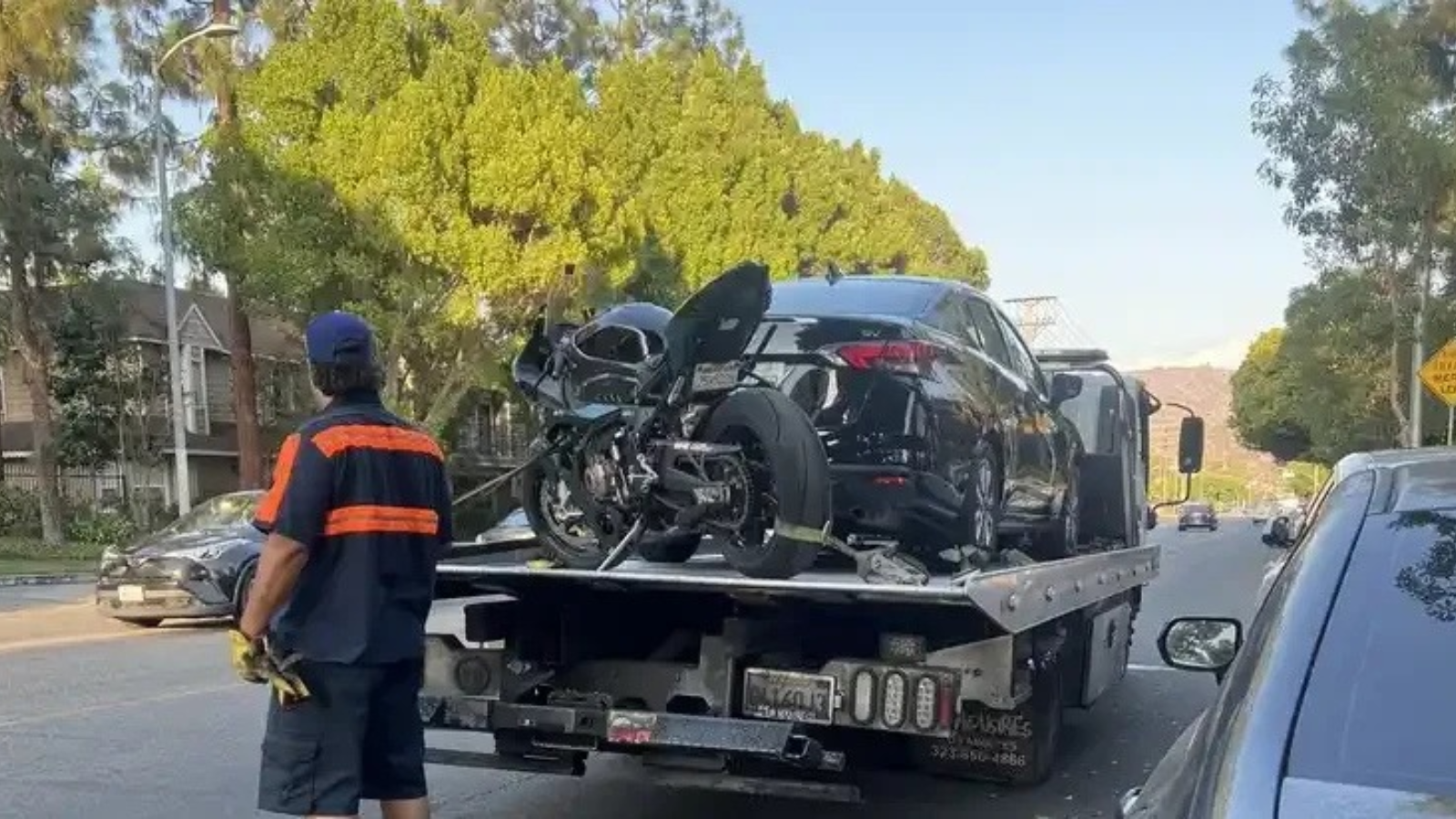
A crash changes your first steps. Call 911 right away if anyone is hurt. Don’t move an injured rider or remove their helmet unless a fire or another danger forces you to. Let paramedics handle that.
If you’re able, photograph the bike, the scene, and the other vehicle’s license plate. California’s DMV reporting rules apply to motorcycle crashes, too. Our guide on what to do after an accident in Los Angeles explains the SR-1 form and other steps. If you can’t ride the bike, our accident towing service can move it to your shop or home.
Frequently Asked Questions
Can a regular tow truck tow a motorcycle?
Not with a standard wheel-lift hookup. A motorcycle needs a flatbed or a motorcycle trailer, plus a wheel chock and soft straps. Ask for that setup when you call.
Can I jump-start my motorcycle with a car?
Yes, but keep the car’s engine off. Connect the positive terminals first, then the car’s negative terminal. Attach the last clamp to bare metal on the bike’s frame. Before you jump, check the kill switch and kickstand.
What should I do if my motorcycle gets a flat tire?
Stop riding as soon as you safely can. A plug kit may work on some tubeless tires if you know how to use one. Otherwise, call for a tow.
How much does motorcycle towing cost in Los Angeles?
The price depends on distance, bike type, access, and the bike’s condition. Call us for a free estimate. You can also read how much a tow truck costs in Los Angeles.
Do you tow motorcycles 24/7 in Los Angeles?
Yes. Certified Roadside Assistance tows motorcycles 24 hours a day, seven days a week. We cover Los Angeles, Malibu, Santa Monica, Beverly Hills, Sherman Oaks, and nearby areas.
Get Motorcycle Towing in Los Angeles Now
A breakdown on a bike feels more exposed than one in a car. Still, the same calm steps help. Get off the road, move away from traffic, make yourself easy to see, and call for the right truck.
When your motorcycle needs help, call Certified Roadside Assistance at (310) 343-3357. For a fix on the spot, ask about motorcycle roadside assistance. For non-urgent questions, contact our team online.
Certified Roadside Assistance
- Address: 2436 Roscomare Road, Los Angeles, CA 90077
- Phone: (310) 343-3357
- Hours: Open 24 hours, 7 days a week